The productivity gains from agentic AI are becoming difficult for me to deny. Give a capable coding agent a clear request, enough context, and a codebase with solid foundations, and it can produce an enormous amount of useful work. Experience amplifies that advantage: seniority helps you define the problem, recognize a plausible solution, spot hidden risks, and know what deserves closer inspection.
But my first reaction to this new way of working was not entirely positive. At times, I felt less like a developer and more like a reviewer waiting for someone else to finish.
The loop was simple: write a request, wait for the agent, inspect the result, then accept it or ask for another pass. Compared with the continuous rhythm of writing code myself, that loop contained strange empty spaces. The agent was working, but I was not. I had removed one bottleneck and accidentally turned my own attention into idle capacity.
The more interesting question, then, is not only how much faster an agent can help us code. It is how developers need to change when coding becomes asynchronous.
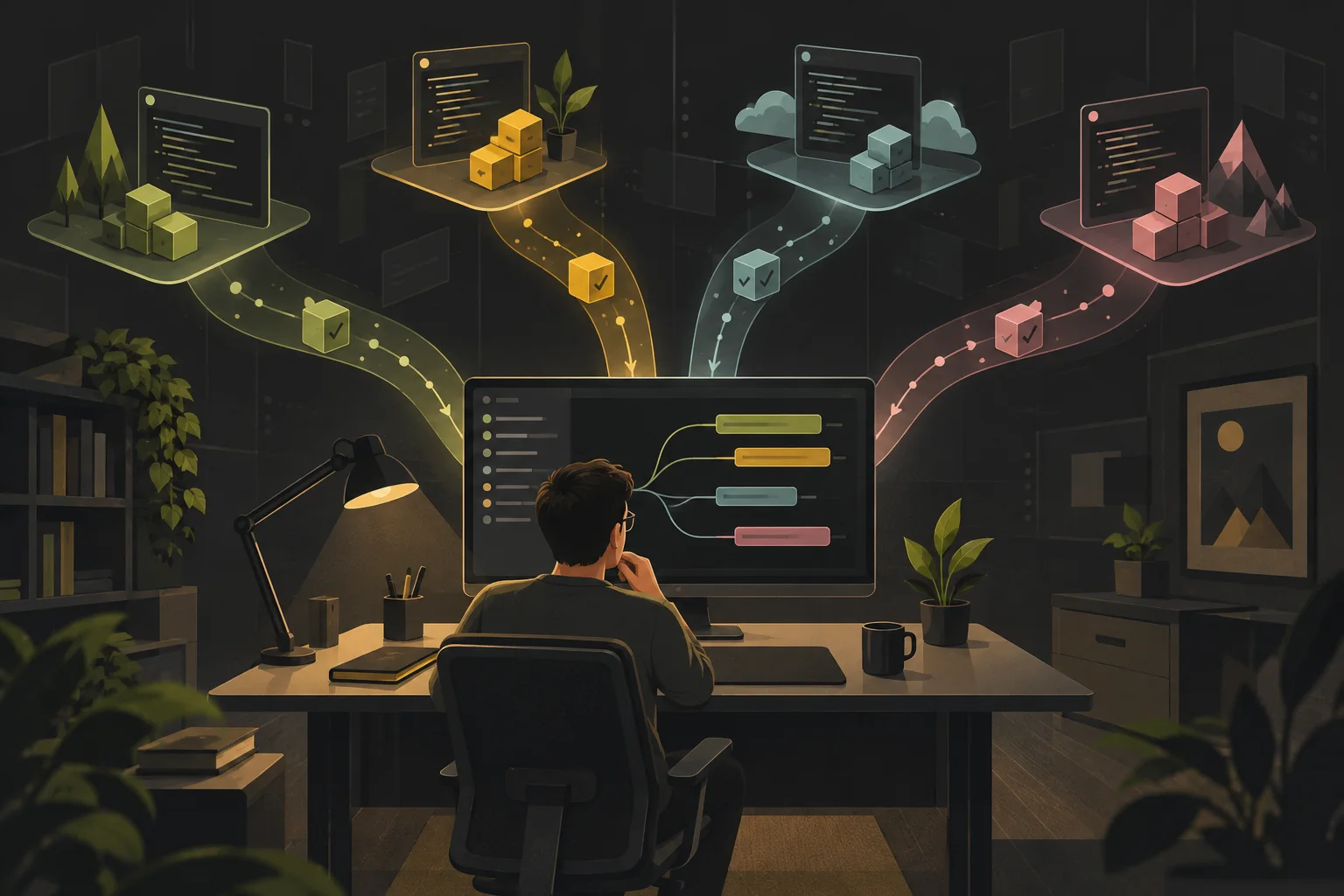
When implementation becomes asynchronous, the developer’s role expands from execution to orchestration.
The waiting is a workflow problem
Our old habits were shaped by direct execution. We held one problem in our heads, wrote some code, ran it, observed the result, and repeated. The feedback loop kept our attention occupied almost continuously.
An agent breaks that rhythm. Once a task has been delegated, there may be nothing useful to do on that exact task until the result returns. Staring at the terminal does not make it finish sooner. Filling that gap with social media does not improve the project either.
My initial mistake was preserving a synchronous mindset around an asynchronous tool. I was using the agent as if it were a faster pair of hands attached to my own brain. A better mental model is a small team, or perhaps a system with several processes in flight. While one stream is implementing a component, another can be investigating an integration, improving documentation, writing tests, or exploring a separate project.
That is where parallelism begins to matter.
From coder to scheduler
Modern processors achieve remarkable throughput partly by keeping multiple operations in progress instead of waiting for each one to finish before beginning the next. Agentic development invites a similar change in how we organize work.
The analogy is useful, but imperfect. Human attention is not a CPU core. Switching contexts has a real cost. We forget assumptions, lose the shape of a problem, and need time to reconstruct why a decision mattered. Running ten agents at once may create ten streams of output, but it can also create a review queue large enough to bury the developer responsible for it.
The goal is not maximum multitasking. It is controlled concurrency.
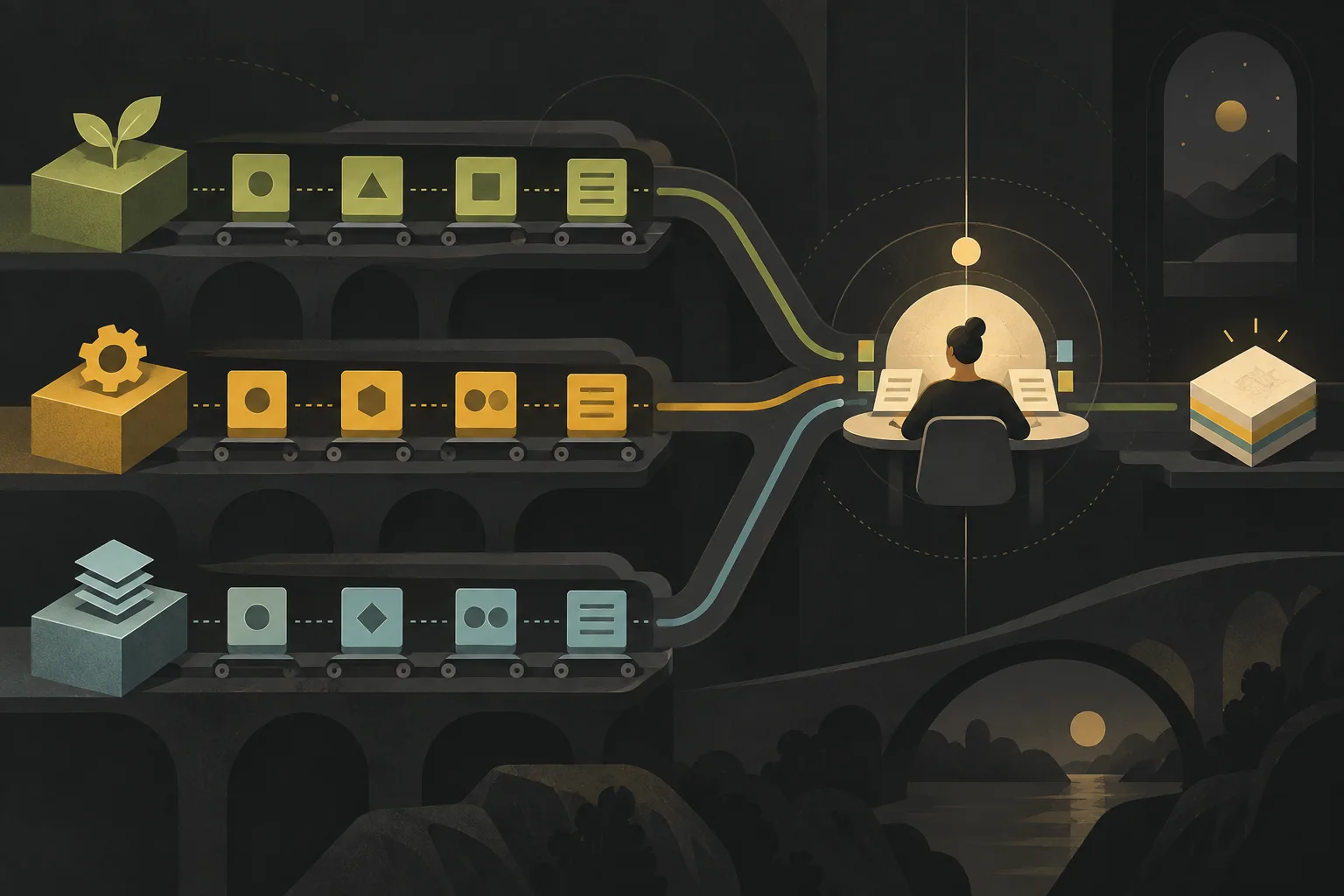
Parallel work creates throughput only when its streams remain independent and review stays deliberate.
For me, that means keeping a small number of independent work streams moving and making each one easy to resume. A useful task has a clear objective, a bounded area of the codebase, an expected outcome, and a way to verify the result. When those conditions are missing, parallel work tends to produce collisions, duplicated effort, or changes that look reasonable in isolation but do not fit together.
The developer increasingly becomes a scheduler:
- Decide which work can safely happen in parallel.
- Give each task enough context to progress independently.
- Preserve the state and intent of each stream.
- Review results according to risk, not just volume.
- Integrate the pieces into one coherent system.
This is still engineering. The work has moved up a level.
Seniority does not disappear; it changes where it pays
Agentic AI is useful at many experience levels, but strong foundations make its output far more valuable. A senior developer can usually describe boundaries more clearly, identify which tasks are independent, anticipate failure modes, and challenge an answer that merely looks convincing.
That last point matters. Accepting generated code because it compiles is not the same as understanding whether it belongs in the system. An agent can accelerate implementation, but it does not remove responsibility for architecture, security, maintainability, or product intent.
In fact, faster generation can make judgment more important. When code was expensive to produce, implementation speed was often the limiting factor. When code becomes cheap, deciding what should exist and validating that it behaves correctly becomes the scarce resource.
Seniority is therefore not a magic prompt-writing advantage. It is leverage built from mental models: knowing how systems fail, which shortcuts become permanent, what to test, and when a request is solving the wrong problem.
The mind needs a new kind of training
Working this way requires mental flexibility, but I do not think the answer is to train ourselves to juggle an unlimited number of tasks. That would confuse busyness with performance.
The more useful skill is fast, reliable context recovery. Before switching away from a task, I need to leave behind a compact checkpoint: what we are trying to achieve, what has been decided, what remains uncertain, and what result I expect next. When I return, that checkpoint should restore the important parts of the problem without forcing me to reconstruct everything from memory.
Good boundaries matter too. Two agents editing the same core module are not meaningfully parallel if their work must later be untangled. Independent features, research, tests, documentation, and isolated fixes are better candidates. Parallelism works best when tasks share a destination but not a collision zone.
I am also learning to match review depth to risk. A copy change and a database migration do not deserve the same level of scrutiny. Neither do generated tests and authentication logic. If every output receives a quick superficial review, parallelism only helps us produce mistakes faster.
A practical rhythm
This is the part I want to make habitual. I remember it as six verbs: split, start, switch, save, review, and limit.
- Split: Break the work into outcomes that can be verified independently.
- Start: Launch only one or two agent tasks, each with clear boundaries and acceptance criteria.
- Switch: Use the waiting time for a genuinely separate task, not another change in the same fragile area.
- Save: Before changing context, record the goal, decisions, open questions, and expected next result.
- Review: Understand completed work before starting another stream.
- Limit: Keep the number of open tasks low enough that you still understand the whole system.
The rule is simple: keep one or two independent tasks in flight, leave a checkpoint before every switch, and review the output before creating more work.
This is less exciting than launching a fleet of agents, but it is more sustainable. The purpose of parallelism is not to maximize the amount of generated code. It is to shorten the time between an idea and a trustworthy result.
The next performance gap
I believe agentic AI can produce tremendous gains, especially for developers with strong technical foundations. But the tool alone will not make every developer equally productive. The difference may increasingly come from how well we decompose work, communicate intent, manage several asynchronous threads, and apply judgment when the results arrive.
At this stage of AI development, a high-performing developer may look less like the fastest person at the keyboard and more like someone running a small, disciplined engineering system. They know when to delegate, when to stay focused, when to switch, and when to stop creating new work until the existing work has been understood.
I am still training that part of my brain. The uncomfortable waiting gaps were not proof that the agent had taken away the work. They were a sign that my old workflow no longer matched the speed or shape of the new tools.

The next step is not learning to type faster. It is learning to conduct.